
It wasn’t until my junior year in college when I took ornithology and started watching birds. My first bird guide was a Peterson. We didn’t ask for a bird guide when we wanted to look up that bird on the fence post, we asked for a Peterson. If you were a serious birdwatcher, you had a Peterson with little stick-on tabs marking the pages so you could go to the sparrows or shorebirds quickly.
People have always watched birds but until the late 18th century, interest in birds revolved mainly around their use as food. But at the dawn of the Victorian era in the mid 19th century birds became subjects of both serious study and decoration as well as food and decoration. Exploration was expanding and the specimens brought back to Europe piqued the public’s interest. Collecting bird skins and eggs, keeping caged birds, acquiring bird art and identifying new species were common interests.
In 1904 a Bird-Land camera for wildlife photography was invented and in 1912 the first exposition of bird photography was held in London. Now birdwatchers, artists, and naturalists could take photos of birds in the wild. Bird banding (ringing in Europe) also became popular in the early twentieth century, so capturing birds alive for study somewhat replaced shooting them. In the late 1800’s the first laws were passed to protect birds and habitats. The federal Migratory Bird Treaty Act of 1918 was enacted in 1916 to implement the convention for the protection of migratory birds between the United States and Great Britain for Canada. And then came field guides.
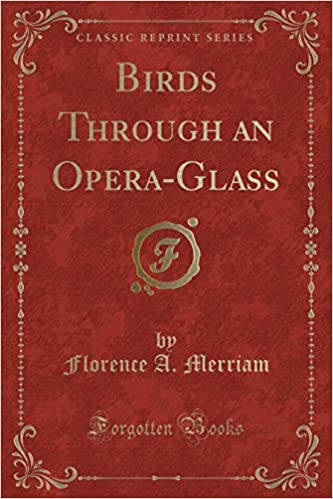
First came local guides like Archibald Thorburn’s 1883 Familiar Wild Birds (of Scotland). Ludlow Griscom published Birds of the New York City Region in 1923. In 1931 Neville Cayley wrote What Bird is That, an enormously popular guide to the birds of Australia. The first field guide to birds in the U.S. was Birds Through an Opera Glass (1889) by Florence Merriam Bailey, and in 1902 she published the Handbook of Birds of the Western United States. In 1905 Chester A. Reed’s bird identification book sold 600,000 copies.
Later came a revolution. In the early 1930’s Roger Tory Peterson, frustrated by existing bird guides at the time, decided to write his own. He drew the birds so that the most important features for identification, now called “field marks”, were shown and described in the text. After being turned down by several publishers, Houghton-Mifflin took a chance and in 1934 printed 2000 copies of A Field Guide to the (Eastern) Birds. They sold out immediately. In 1941 a western edition was added. Today the Peterson Field Guide series is comprised of dozens of field guides by various authors of seashells, lizards, fish, and rocks, as well as birds.
There were and are many other field guides in the U.S. and around the world, but Roger Tory Peterson’s has to be the iconic one which has arguably become the model for all natural history field guides worldwide.
Dear Professor, if Merriam-Bailey’s was the first field guide then what was Robert Ridgeway’s A Manual of North American Birds, which was published earlier in 1886?
Ridgeway’s was not a field guide at 643 pages. It included detailed keys of all the orders and families – great for laboratory or classroom use, but not in the field.
Thank you Professor for your timely response!
Another query if you please—Are you familiar with Irene Grosvenor Wheelock’s, Birds of California (1904)? Do you by chance know if this might be considered the first field guide published for California Birds?
Thank you again.
Kind regards,
Cathy
I am searching the best ebook writing servicesprovider because I am writing the first bird guides for my own publisher name.
Wow, I’m pleased to have stumbled onto this debate regarding The First Bird Guides! As an enthusiastic fantasy reader, I’m always looking for new worlds to discover and animals to meet. If anyone wants help creating their own fantasy worlds, I recommend visiting Fantasy Book Writing Service for experienced advice. Happy reading, fellow fantasy aficionados!
Wow, this is fascinating! The evolution of birdwatching and the impact of field guides like Roger Tory Peterson’s is truly remarkable. It’s amazing to see how this passion has grown over time. The mention of ‘venture capitalist‘ adds an interesting twist to the narrative!
What an incredible journey through the evolution of bird guides! From Peterson’s iconic field guide to the pioneering spirit of early birdwatchers, it’s fascinating to see how passion for birds transformed into such a crucial tool. Just as Peterson’s guide became the model for all natural history field guides, the largest vc firms Pakistan are shaping the future of investment with similar groundbreaking approaches.
Such an informative and engaging post! It’s fascinating to learn how birdwatching has evolved over the years, from hunting to the incredible field guides we use today. I had no idea how influential Roger Tory Peterson’s work was in shaping the way we observe and identify birds. The history behind these guides adds so much depth to the experience of birdwatching itself. Your post makes me want to revisit my own bird guide collection and appreciate their role in natural history.
Speaking of guides, if you ever think about compiling all your birdwatching knowledge into a book, I recently wrote a step-by-step guide on how to write a book—it might be a fun way to turn your expertise into something lasting! For book writing queries, please connect.
Drift Boss is not just a normal racing game, but also a battle of ingenuity and quick reflexes. Do you have enough courage to overcome all challenges and set your personal record?