
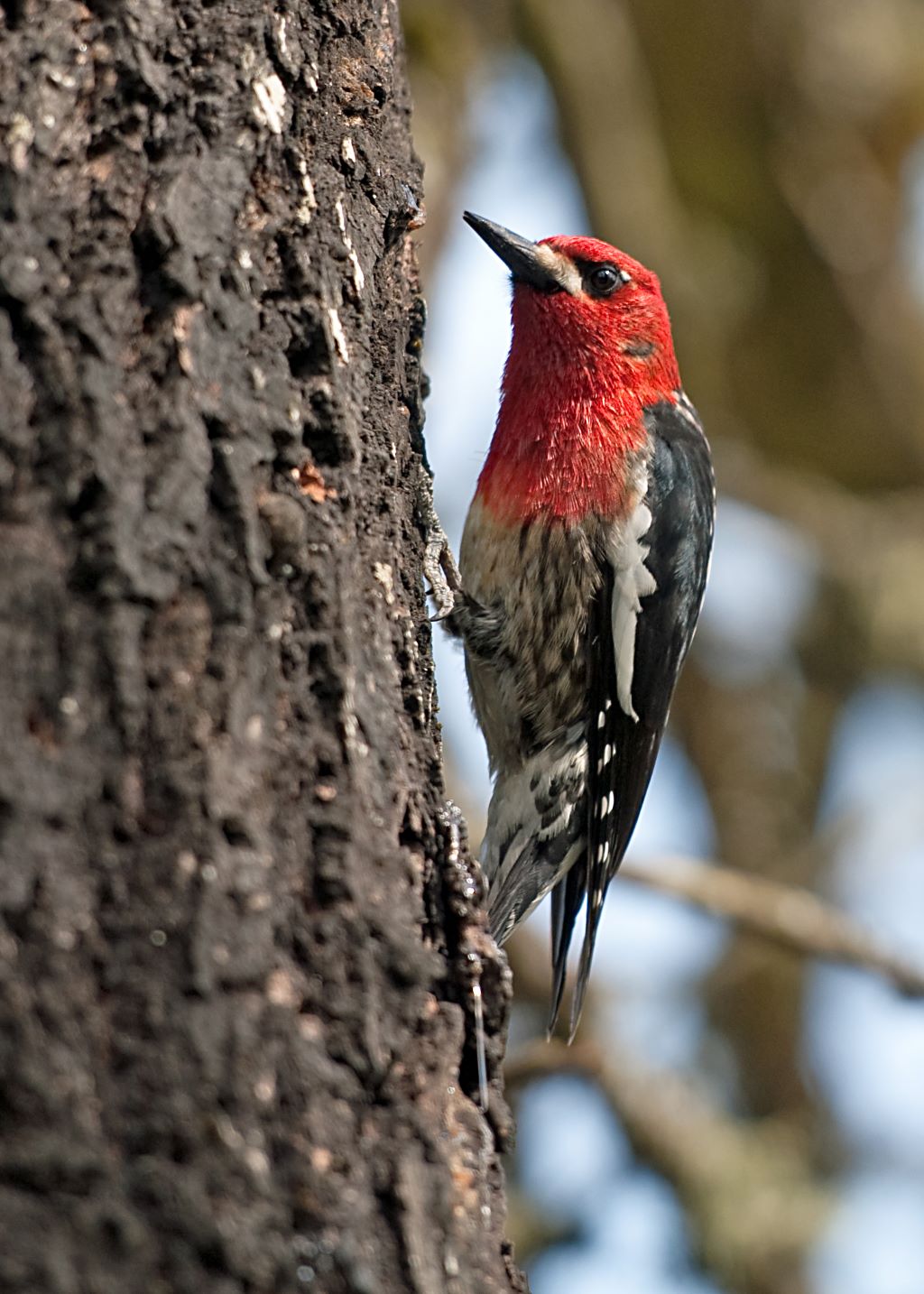
I once thought that the name “sapsucker” was a pejorative appellation laid upon someone or just another version of “seersucker.” The latter is a type of cotton fabric and the former is actually a type of bird.
There are four species of sapsuckers in North America: the Williamson’s, Red-breasted and Red-naped Sapsuckers are western species and the Yellow-bellied an eastern variety. All are migratory, nesting in the northern regions nearly to Alaska and wintering as far south as Panama. Winter is the time you are likely to see these birds in the lower elevations of the west.
Sapsuckers are specialized kinds of woodpeckers. Most woodpeckers peck on dead or dying trees to extract nuts, seeds, and arthropods and their larvae from the tree. The sapsuckers, however, prefer live trees in which they drill a series of small holes in a more or less parallel pattern, giving the tree the appearance of being machine-gunned by a very small gangster. The birds leave the tree to ooze its sap. When the sapsuckers return, they feed on both the sap and the insects that are attracted to it.
All woodpeckers have a specialized tongue supported by a series of bones that wrap around the jaw and over the top of the head. This allows the birds to extend their tongues far out of their bills to reach food in crevices or holes. The sapsucker’s tongue is also fringed along its front portion, the hairlike fringes acting like a mop to soak up the sap. Appropriately, a group of sapsuckers is known as a “slurp”. (Hummingbirds will make use of these sap wells and eat the sap and insects attracted to it as well.) Red-breasted Sapsuckers nest primarily in conifers or soft deciduous trees such as cottonwood or aspen. Four or five eggs are laid in a nest simply made of wood chips from the nest excavation. The sapsucker will drill a series of test holes in various trees while searching for a nest site and nest near the trees that produce the most sap. Young sapsuckers will spend several weeks with their parents learning how to drill holes.
Sapsuckers usually do not pose a problem for trees. Enlargement of their sap holes by later borings allows cambium, inner bark and more sap to be eaten. Such repeated attacks can girdle and kill branches or the entire tree, but this is rare. Insects, porcupines, or squirrels may be attracted to the oozing sap and fungi and bacteria may enter through the feeding wounds. Again, not usually. One can discourage sapsucker feeding on a tree by wrapping hardware cloth around the tapped area, or smear on a sticky repellent, but this might just drive them to another nearby tree.
Sapsuckers, like all woodpeckers, are protected by the Federal Migratory Bird Treaty Act. For the most part, sapsucker damage is just part of living with nature, something to be endured as an occasional inconvenience. Just be glad that they are drilling into your trees, not your house’s siding.
Hi! Against the background of other platforms https://1win.com/ looks confident. Fast access, simple authorization, withdrawal of money without problems. The level of service is high, and the bonus system is transparent. No tricks – everything really works as stated.
As a new user and just a reader of the site, I found this text to be easy to understand and enjoyable to read, even without any special knowledge of ornithology. The author starts off with an interesting personal mistake about the meaning of the word “sapsucker,” which immediately grabs your attention, and then logically and clearly explains the difference between the species of these birds and their habitats. I liked that the information was presented calmly and without overloading the reader with facts, but at the same time gave a clear idea of migration and the seasonality of observations. At the same time, while browsing through the various sections of the site, I noticed https://www.nastyhookups.com/kink-dating.html — a service where it is convenient to meet people with open minds and specific interests. The site looks structured, with active profiles and an understandable communication format. In general, both the text and the resource itself leave the impression of a light, informative presentation without putting unnecessary pressure on the reader.
This was such an interesting and informative read! I never realized how specialized sapsuckers are compared to other woodpeckers, especially the detail about their tongue acting like a mop for sap. The article does a great job of mixing science with easy-to-understand explanations, which makes learning about these birds really enjoyable.
Really enjoyed reading this! I had no idea sapsuckers were so different from other woodpeckers, especially the way they drill sap wells and use their unique tongues to collect sap. The article explains everything in such a simple and engaging way that it keeps the reader interested from start to finish. Nature truly has some fascinating creatures!