
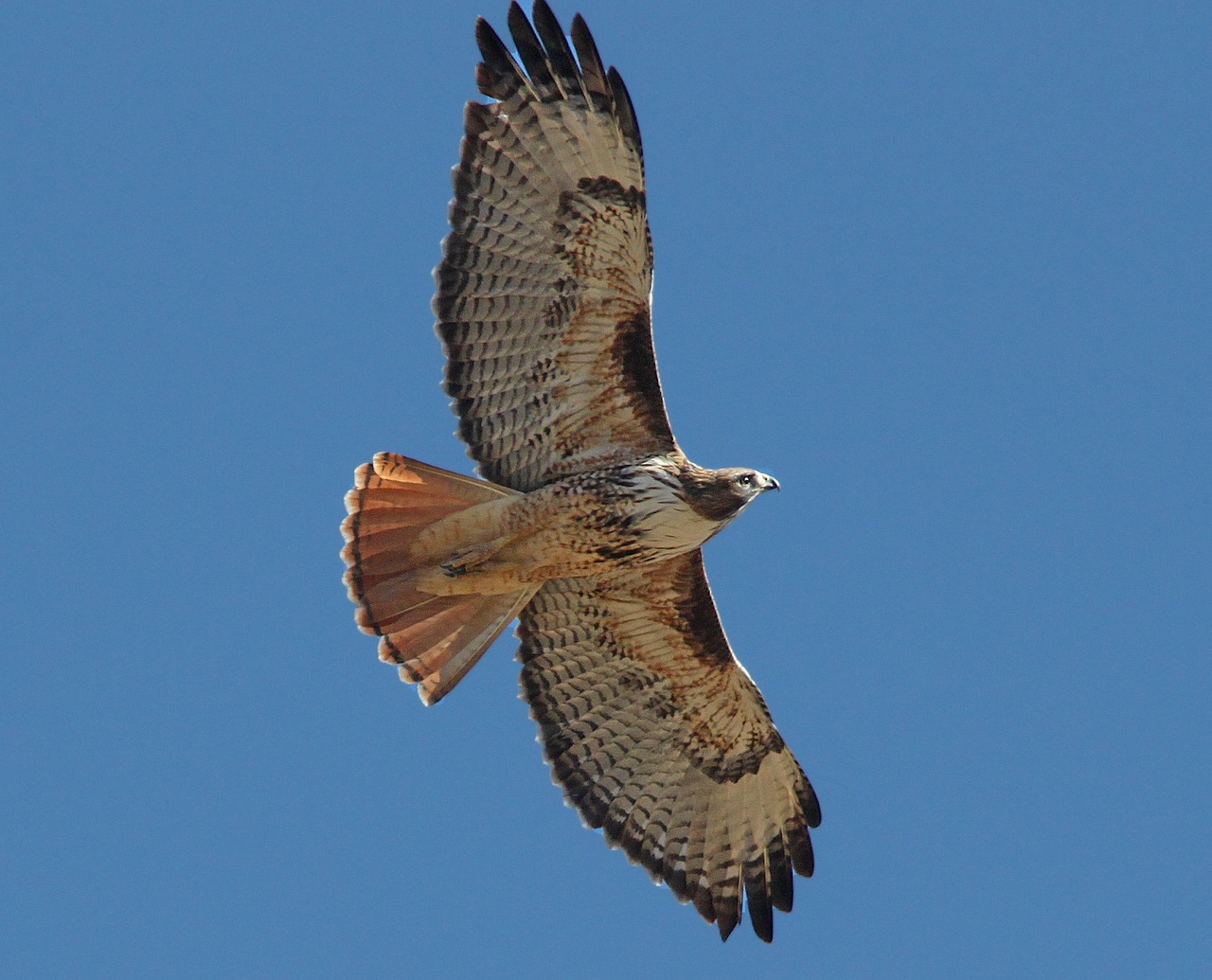
The Red-tailed Hawk (along with the Cooper’s and Sharp-shinned Hawks) was once called a “Chicken Hawk,” and the Red-shouldered Hawk was known as the “Hen Hawk.” Undoubtedly, they took a few chickens—but only rarely. Like most stories of wild predators attacking domestic animals, their impact was greatly exaggerated. There’s one story about a farmer who released a flock of 50 Cornish hen chicks, returned an hour later to find 48 dead, and immediately blamed birds of prey. More likely, it was a neighbor’s dog or cat—but the poor hawks got the blame.
A survey conducted by the U.S. Fish and Wildlife Service estimated that the total monetary damage caused by all raptors on agricultural property was less than $200,000 nationwide—for all hawks and owls combined.
I was watching a Red-shouldered Hawk in my backyard the other day, listening to its distinctive cries; it is certainly one of the most vocal hawks. It had a lizard in its beak, though they eat a wide variety of small mammals, birds, and even crayfish. Although “red-shouldered” may seem like a misnomer—since their entire breast appears reddish-brown—that description applies primarily to the California variety. Four other forms of the Red-shouldered Hawk are found, mostly east of the Mississippi River. The larger Red-tailed Hawk, by contrast, is found throughout the United States and Canada.
Eastern Red-shouldered Hawks are identified by their reddish shoulders rather than their breast, though all varieties share barred wings and tails. Red-tailed Hawks prefer open habitats, while Red-shouldered Hawks favor wooded areas and seem somewhat less fearful of people.
Red-tailed Hawks display a wide range of plumage, from very light to very dark, but most have a distinctive dark breast band contrasting with a lighter chest. They typically live six to eight years and do not develop their characteristic reddish-brown tail until about their second year. Red-shouldered Hawks acquire adult plumage in their second year and generally live only two to three years.
In flight, the Red-shouldered Hawk moves quickly, with three to five shallow wingbeats followed by a glide. When soaring, its wingtips droop slightly. It has a longer tail and does not hover. The Red-tailed Hawk, on the other hand, has slower, deeper wingbeats and often soars with its wings held in a slight V-shape. These flight differences relate to each species’ preferred habitat. The Red-shouldered Hawk’s longer tail aids maneuverability in wooded areas, where soaring is less practical. The Red-tailed Hawk’s shorter, broader tail helps it soar efficiently over open landscapes while searching for prey.
Ever wonder how a hawk spots small prey from hundreds of feet in the air? In part, it’s because their eyesight is far sharper than ours. Hawks possess roughly five times as many photoreceptor cells as humans. There is also evidence that they use ultraviolet vision to detect prey, as the urine of animals like mice and voles reflects UV radiation—the fresher the trail, the brighter it appears.
Because they are common and relatively easy to train as skilled hunters, most hawks captured for falconry in the United States are Red-tailed Hawks. Falconers are permitted to take only “passage” hawks—young birds less than a year old that have left the nest but have not yet begun breeding—so as not to affect the reproductive population. Adults may not be taken, and doing so is illegal. Passage Red-tailed Hawks are preferred because they have not yet developed the adult behaviors that make older birds more difficult to train.
I believe your statement about when a Red-tailed Hawk gets its red tail is incorrect. Other sources, as well as personal observation, indicate the red tail feathers appear during molt at the beginning of the second year.
You are correct, although the full adult plumage and the eye color take three years.
Hi, could you help me out on an ID please ? My best guess is a juvie eastern redtail. 2022-6-13 at roughly 8pm I saw a bird fly across my shady backyard in Round Rock TX, and it flew under tree canopies and perched on a live oak limb about 8 feet high in the next yard where I had a clear view of it in my Nikon Monarch 10×24 bins. At first I thought it was a whitetail dove as it looked gray and white in flight, but it flew a bit differently (more gliding and less flapping) and looked a little too big for a dove (but smaller than redtails I’ve had in my yard). Generally grayish on top (it was in a heavily shaded place with the daylight fading a little), with a black crown. Generally off-white underneath. “Brown and white stripy pants” – I guess a chestnut and ivory, like the stripes on a cooper’s hawk. Stripy chestnut tail. It was perched facing away from me (and my Sibley’s unfortunately has no perched pics of them) but occasionally looked to the left. Bottom part of face was whitish, top part grayish. Yellow or orange eye. What do you think ?
I am sorry but your description doesn’t allow me to identify this bird.
Pingback: Differences: Hawk, Falcon, Eagle, Osprey, And Kite – All The Differences
That’s good info
I noticed that the Red-shouldered Hawk is described as very vocal. It reminds me of hearing them near the woods when hiking. Also, it’s interesting how they prefer wooded habitats unlike the Red-tailed Hawks. Such differences make these birds fascinating to watch!
When I read about the $200,000 monetary damage caused by all raptors combined, I was surprised. It’s a stark reminder not to overestimate their impact. Seeing a Red-shouldered Hawk with a lizard in its beak in a backyard setting is fascinating-how often do we really notice these details in our own backyards?
This is a thoughtful take on red hawks. The practical examples really help illustrate the concepts. If you want a related example, Songonlyone is worth a look.
As a birdwatcher, I’ve always admired the red hawk’s impressive hunting skills. It reminds me of how strategic thinking in dordle can be! Balancing patience and precision is key in both pursuits.