
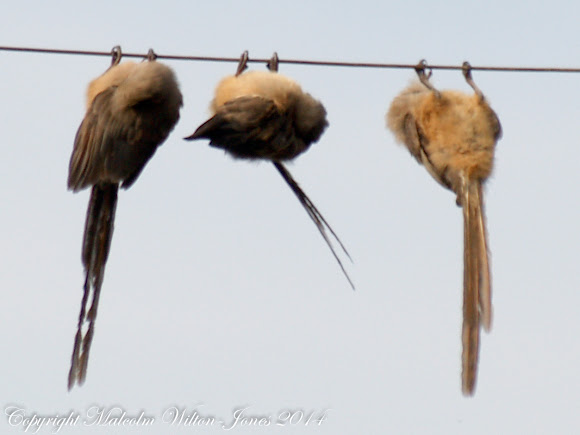
Mousebirds, sometimes called Colies, and found only in sub-Saharan Africa, are so named for their mousy color and their behavior as they move gingerly through the vegetation searching for food and scurry along the ground between bushes. Slender greyish or brownish birds with soft, hairlike body feathers, crests, curved claws, and stubby bills, mousebirds are typically about 5 inches long, with a thin tail longer than the body. They feed on berries, fruit and buds, often hanging upside down.
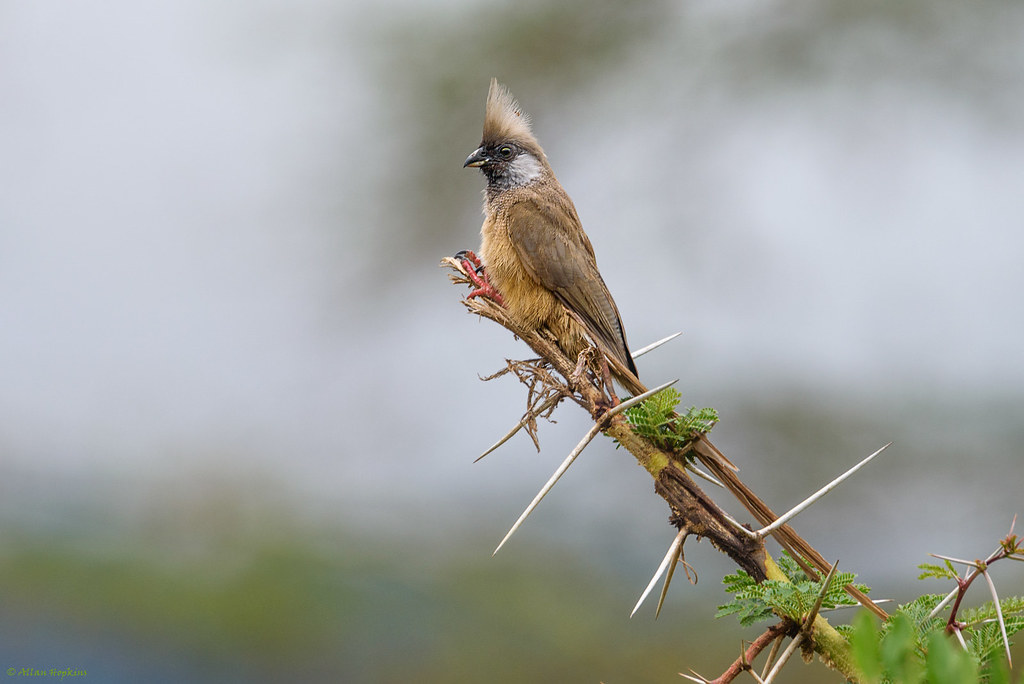
The typical perching bird has four toes, three forward and one back; this arrangement is called anisodactyl (unequal toes). In the case of mousebirds (and swifts) the arrangement is pamprodactyl (equal toes) in which all four digits are forward. Interestingly, mousebirds can swing their outer toes forward or back so that they can adopt an anisodactyl arrangement (three forward, one back), a zygodactyl arrangement (two forward, two back, like woodpeckers), or the four forward pamprodactyl arrangement, depending on what they want to do. The anisodactyl arrangement serves well for perching, the zygodactyl arrangement for climbing tree trunks, and the pamprodactyl arrangement for hanging upside down or clinging to vertical surfaces. They often hang upside down when sleeping.
Mousebirds are very social, feeding in groups and engaging in mutual preening. At night, they roost in very tight groups of 20 or so birds. Studies have shown that mousebirds, clustering together at night to share body heat, reduce their nighttime energy expenditure by 13% if two birds huddle, 31% for four birds, and 50% if six or more birds are in the huddle.
Mousebirds fly in family groups in single file alternating humming wingbeats and gliding. In the air, mousebirds are clumsy, often beating their wings rapidly while appearing off balance and crash landing into bushes or trees. Another unusual behavior is their ability to drink water without tilting their heads back, something shared only with pigeons and doves.
Their appearance and behavior make them unusual birds. Mousebirds belong to the Order Coliiformes, the only bird order confined to Africa. The present species lineup is a shadow of their ancient lineage as there once were four families and a couple dozen species of mousebirds.
Today, in the family Coliidae, there are only six species in two genera:
Urocolius indicus, Red-faced mousebird
Urocolius macrourus, Blue-naped mousebird
Colius castanotus, Red-backed mousebird
Colius colius, White-backed mousebird
Colius leucocephalus, White-headed mousebird
Colius striatus, Speckled mousebird
The White-backed Mousebird is found in South Africa. The Blue-naped Mousebirds are found in the drier regions of East Africa. Speckled Mousebirds are found in Eastern, Southern, and Central Africa. The Red-backed Mousebird is a resident of Angola and the Democratic Republic of the Congo and the Red-faced Mousebird is common in southern Africa from Zaire, Zambia and Tanzania south to the Cape.
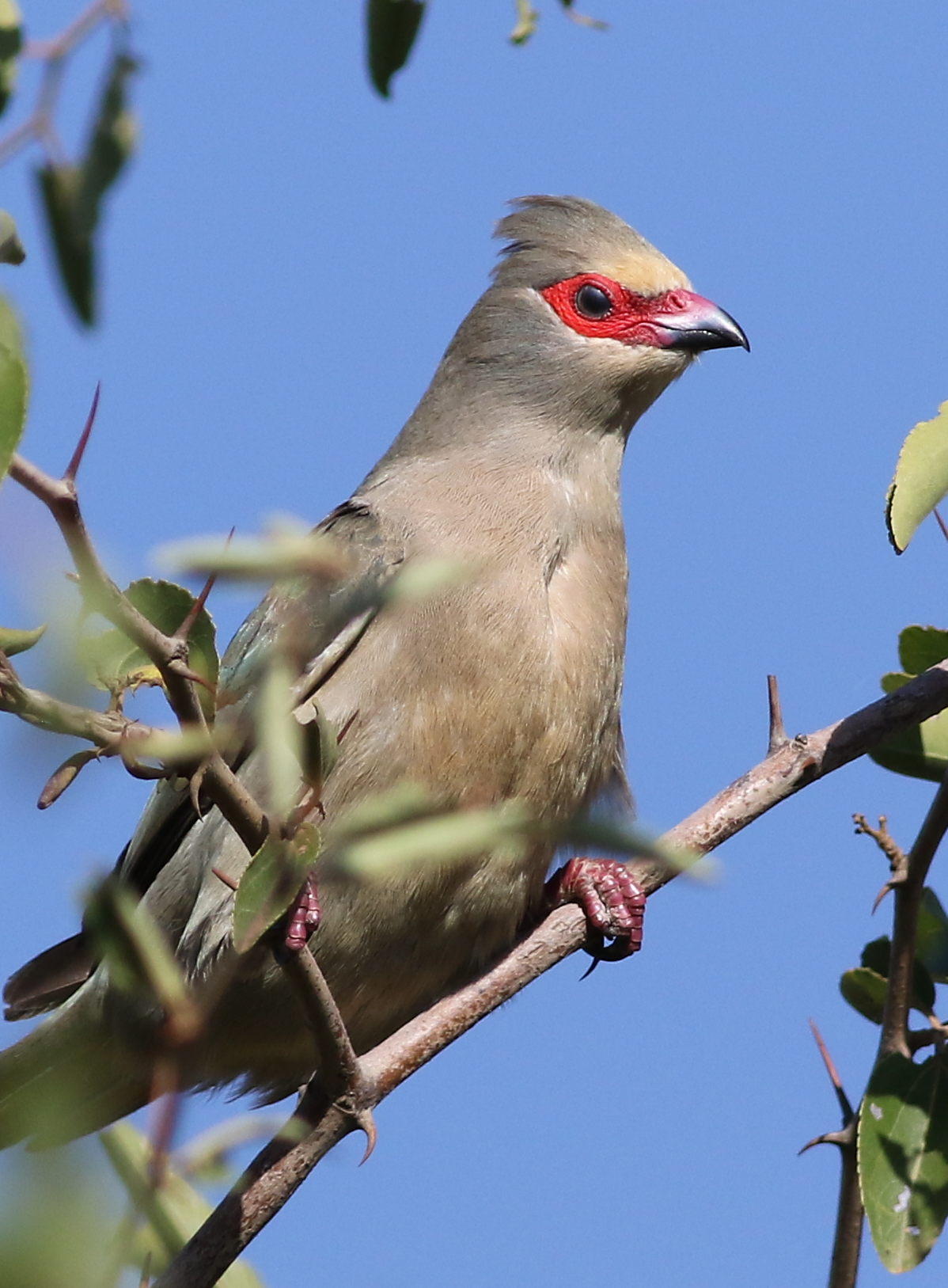
All six species of mousebird appear to be doing well — none are currently thought to be declining in range or numbers. Mousebirds are fascinating and common but because they have adapted to human habitats in many areas are even considered a pest because they often damage fruit trees. They have also been introduced to the caged bird market.
Thank you very much for this nice and important information on speckled mousebird
They used to hang upside-down on the wires outside the office when I was in Nairobi. I thought they were odd, but interesting to watch. Interesting that they are found only in Africa. East Africa is a great place for bird-watchers!
Fascinating birds with truly unique adaptations, especially their flexible toe arrangements and social roosting behavior. Mousebirds are a great reminder of how diverse and specialized avian evolution can be in Africa.
I’ve owned several types of birds in my life, but never these…may be an interesting species, as they appear to socialize quite well to human care (especially from a young age). On many videos, they seem to enjoy people and will hang upside down off of your finger. 🙂
The discussion about mousebirds raises some really valid points. This perspective is refreshing.
Sofia574
As an avian researcher with a focus on adaptation and behavior, I truly appreciate your in-depth exploration of mousebirds! Their unique locomotion is not only fascinating but also highlights the incredible adaptability of birds to their environments. It would be interesting to consider how these adaptations could inform conservation efforts, especially as habitats continue to change globally. The Snow Rider 3D details you’ve provided about their social structures also raise intriguing questions about cooperation among species. Thank you for shedding light on this unique group—it’s discussions like these that contribute greatly to our understanding of avian biodiversity!
Finding creative solutions to maximize monthly savings inside bills must be paid adds a rich extra layer of fun that every strategy enthusiast should experience.