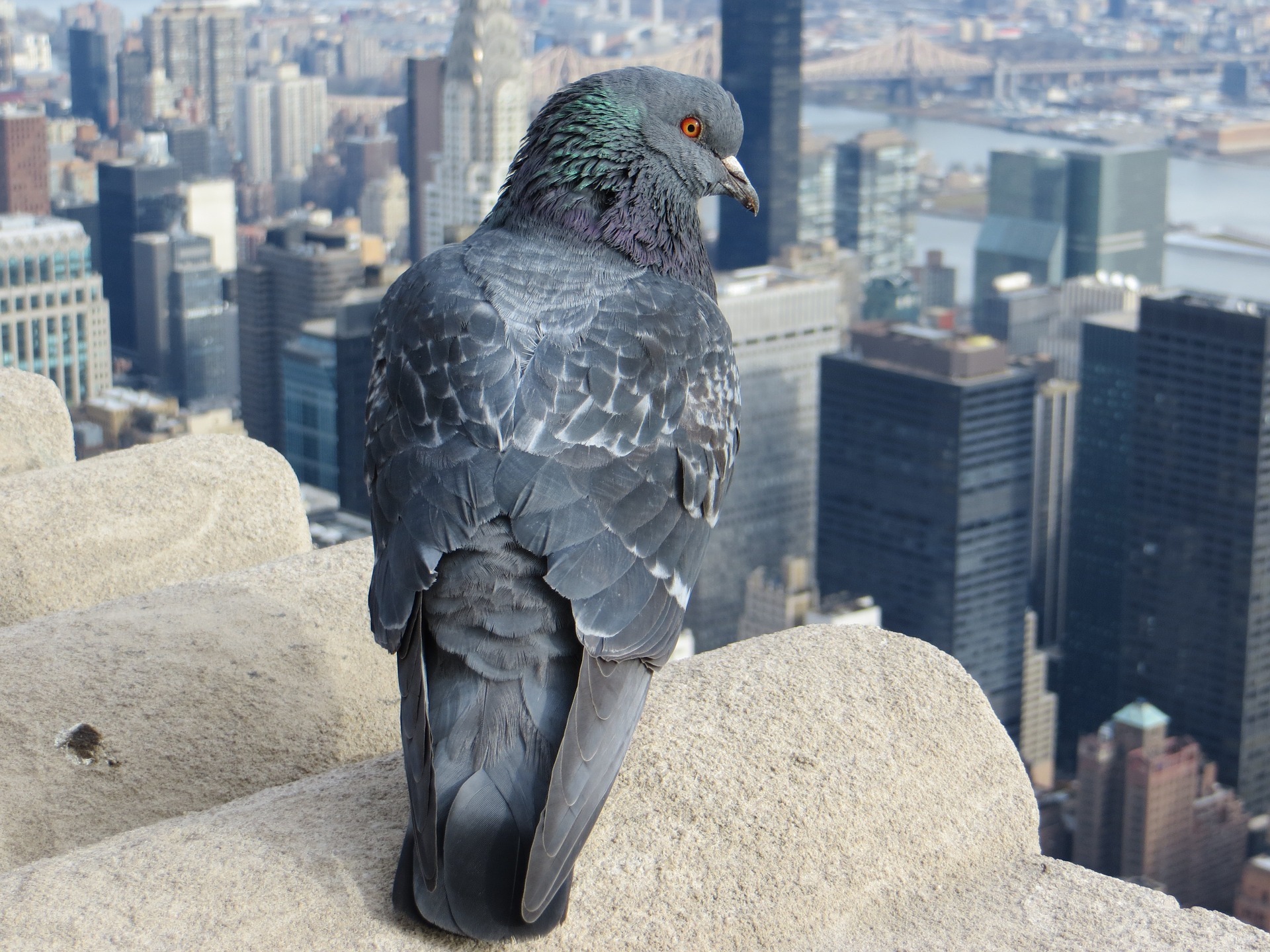
Just returned from a week in New York City. Of course, the only birds I saw in
Manhattan were the usual suspects: Eurasian Starlings, Rock Pigeons, and House
Sparrows, all well adapted to urban life. Why is it they are so good at
surviving the crowded urban jungle? Yes, a number of other species are found in
the green oasis of Central Park, but I’m talking about the denizens of places
like the Lower East Side, Greenwich Village, and Times Square. Where do these
birds get food, water, and shelter and how do they survive the cold winters?
Pigeons, starlings, and House Sparrows are originally from a wide
geographical area of Eurasia, spread over thousands of miles east and west and
north and south. Their populations evolved adaptations to a wide variety of
climatic conditions and when they got transports New York and other areas they
readily adapted.
Food? A casual walk through the Big Apple reveals remnants of uneaten human
food, most fast food, strewn about on the sidewalk, in the gutters, surrounding
street vendor carts and around garbage bags. Numerous outside eateries add to
the organic litter on the sidewalk. Access to sufficient food seems to be no
problem. Water? The gutters provide an ample supply, either from rain, street
cleaners, a leaky faucet, or dew dripping from awnings and ledges. Shelter and
nesting? There are innumerable niches in and around buildings on ledges, behind
gutters, in light fixtures, recycle containers, and random patches of greenery.
Pigeons, starlings and House Sparrows do well in the big city in spite of
its overwhelming urbanization. In fact, these three species plus the Barn
Swallow occur in 80% of the world’s cities. But in its earlier years, in the
late 1800s, the most common urban bird in New York was the Chipping Sparrow.
Today only the hardiest of avian species survive the sidewalks of NYC.
Around the world Rock Pigeons, Eurasian Starlings, and House Sparrows are
almost ubiquitous but there are about 200 species of birds that have adapted to
city life. Mynah birds are common in the cities of India and blackbirds are
found all over Europe. In fact, over 20% of the world’s bird species inhabit
cities – 2,041 of them. Of course, if you include all the habitats of New York
City, including Central Park, you can actually find about 210 species, although
several of these are uncommon or rare. What’s the birdiest city in the world,
you ask? It is Cali, Columbia, with an amazing 540 species found in the city
limits.
Know what else is amazing? It seems logical that a natural habitat, like a
forest, would contain the greatest number of species and that increasing
urbanization would cause a proportional decline in bird species numbers. Not
exactly true. It turns out that, of all the possible species to inhabit a
geographical are, the greatest number are in the somewhat urbanized area. The
undisturbed area contains the next highest number and the totally citified area
the least. Ornithologist John Martzleff calls this phenomenon “subirdia.”
Seems like integrating urbanization with natural habitat provides the best of
both worlds.

This is a thoughtful take on birds of the big apple. The practical examples really help illustrate the concepts.
https://songonlyone.com