
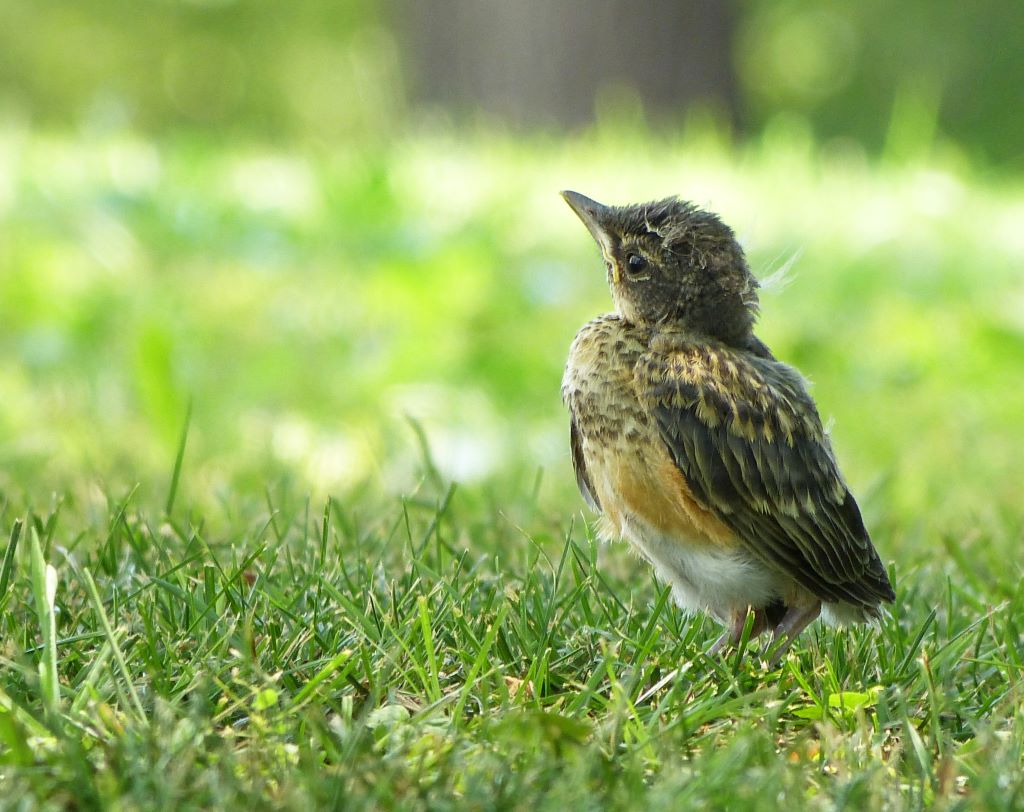
 This is the time of year when birds begin their reproductive cycle in the northern hemisphere. People find eggs, nests, and baby birds and try to help them. Generally, that is not a good idea. Only 10-20% of songbird eggs ever result in an adult bird. The eggs might be infertile, die during incubation due to genetic or environmental causes, or be eaten by predators. Weather might blow the nest out of the tree or the young might starve. When young birds leave the nest they cannot fly and are still dependent on their parents and the risk of death from predators and weather is amplified.
During the first five days after hatching, baby birds are blind, naked, helpless and cannot maintain a steady warm body temperature. During the next five days or so their eyes open, they develop thermoregulation, and grow some feathers. At about 10 days of age they leave the nest. They are now fledglings. Here’s something that most people don’t realize: the young jump from the nest, unable to fly, and for the next ten days or so are fed by their parents. Unfortunately this stage is when they are most likely to be seen and found by humans.
Humans, being the empathetic creatures they are, feel sorry for this poor bird that “fell from its nest” and try to “rescue” it. Don’t do it. The parents may not be seen but they are there, taking care of their offspring until the young can fly. If you take the bird away, you badly disturb the bird family and you are unlikely to take care of the bird as well as the parents can. And don’t try to return it to the nest. Leave it alone. Repeat: leave it alone.
Occasionally, a young helpless bird falls or is knocked from its nest or a tree trimmer trims the wrong branch and the whole nest comes down. It this case, the babies or eggs will not survive. So what do you do? Well, if you have a bird rehab center in your area, call them. They have the skills and dedication to take care of the birds. But don’t just pick up the bird or egg and take it to a vet or wildlife official or nearest biology department because it is unlikely that they will have the time or resources to devote to hatching an egg and/or raising a baby songbird.
You can try to raise the egg or young yourself, but there are three important caveats here:
- It is VERY difficult to do without experience
- It is VERY time consuming as baby birds need to be fed around the clock
- It is ILLEGAL to do so unless you have a federal permit
Go to the Cornell Laboratory of Ornithology for more information on orphaned birds.
Sure, it’s difficult to leave a baby bird alone when you see it on the ground. But this is how nature has operated for millions of years; human interference rarely helps. So leave the bird be unless you are absolutely certain the bird is abandoned and in trouble and you have a place to bring it for experienced care.
I was picking up tree debris and found a nestling age bird on the ground. We couldn’t locate the nest but placed it in a little alcove (padded with soft palm tree material) up in a tree within feet of where the bird was found. Do the parents find the baby by sound? We hope they will find it. Is there a way for me to send a picture to you to see if you can identify what kind of bird it is. Its black and gray but it’s beak looks like a crow to me.
When you find a nestling, half or more feathered, the bird jumped out of the nest because it was time to do so. Never try to put them back in the nest because they will just jump out again. They cannot fly yet but their parents will take care of them until they can. Just put the bird on the ground under a shrub – the parents will find it and care for it. You can send me a photo at rlederer@csuchico.edu
I found a baby fledgling yesterday. I did not feel there was a safe place to put it as it was in the hot sun and right next to the road. I put it in some nearby woods. Do u think the mom will find it? What is an acceptable radius? It was only a bit down the block. I hope it will be ok.
You did the right thing. I don’t know what an acceptable radius is as I don’t have any idea of your situation. Mom will probably find the baby and all will be ok. Thank you for your concern.
Ty so much. Keep up your good work!
We have a bird house in our yard and I believe a baby was recently born. Today I found a blind baby bird on the lawn and it was raining so I put on a glove and put the bird back in the birdhouse. Did I do the wrong thing?
You may have done the wrong thing. If the bird came from a birdhouse, it probably jumped so it was ready to leave the nest in which case you should not have put it back. It’s not likely it fell out of a birdhouse if that’s where it came from.If it had feathers it was waterproof. By the way, you do not have to put on gloves to handle a bird or nest or eggs. Birds will not be repelled by human smell; that’s a myth.
Thank you Dr. Lederer. Will this harm its development or will it simply leave the nest in the bird house again now?
Only problem might be leaving the nest again. Lots of injuries happen when birds jump from nests.
I see, thank you Doctor!
Baby birds in a vent attached to the house cant get at them but mother is in and out are they going to be able to fly out of the vent when they are big enough
These birds made a nest on top of my wreath. Babies were hatched 1 week ago I’m afraid if they jump they will get injured. What can I do? Move the wreath and put it on the ground?
I found a hatchling (bald and eyes shut) while cleaning in my backyard stuck on its back covered in grass. I put on some gloves and found the only nest I knew of which is high up in the carport of my house. I couldn’t get him in the nest but I placed him next to it and I’ve seen birds in and out of that spot since then, was this the right thing to do?
A bird laid eggs in a styrofoam ice chest under our carport. Everything seemed ok and mom was coming back for a couple of weeks after babies hatched. I just found them all dead.
The nest was never disturbed except for peeking in here and there. Did they most likely die from not being able to jump out? Why would mom let this happen?
Found a fledgling in my back yard. Think it might be blind. Left it for hours no sign of parents. Moved it out of the direct sun. It can fly. Eyes look cloudy. How do you know if it’s blind?
From you brief description, things seem normal. Parents are likely around somewhere. Cloudy eyes just means that a normal (called nictitating membrane) is over the eye. If it can fly, it’s certainly not blind.
I have 4 baby birds in a nest in my fern and as I read how they will jump out of nest it really makes me sad as there are several feral cats around here. I don’t feed them but they hang out around here and sometimes I find one sleeping in ricking chair on porch. Is there nothing I can do to save these baby birds from the cats because I know if it’s on the ground they will find them and eat them?
Bence doğaya bu şekilde bırakmak yüzde 50 yaşam yüzde 50 ölüm demek, ben uçana kadar bakma taraftarıyım, en azından uçtuğunu görmeliyim , hem küçük hem hava soğuk yuvası yok daha annesi var mı diye etrafta bi yere koysam anında kedi dostlara yem olmayacağını nerden bilebilirim, öyle bir şey olursa daha çok üzülürüm o sebepten aldım besliyorum gayet de sağlıklı ve uçacak 1 kaç hafta sonra evet beslemek çok zaman alıyor ama olsun bakıyorum hem de mis gibi ve çok tatlı
We found a baby bird under a tree. We took it home and only now I know we shouldnt have. We feed it with cats whiskas, eggs, buckwheat. It’s been with us for 6 days now. At the beginning was jumping in the box, tryi b to get out,. Now it isn’t. It doesn’t move much. Has great appetite and reacts when he sees us. Is it too late to bring it back under the tree..?
Sorry I responded so late. I don’t know what you did with the bird but you are correct – you should not have taken it home. If it is domesticated now it will not survive in the wild.
On another subject; I have a hummingbird feeder in my yard, but no hummingbirds this year, However the Baltimore Oreals
ls really love it. It is such a treat to see them eat from that little feeder. Is this a normal activity?
Orioles often come to hummingbird feeders. Not unusual at all.
I found a baby robin who I think may be blind in one eye and cannot fly very well (I’m assuming because the baby can’t see very well). He’s bumped into things a handful of times and I am not sure how to handle the situation. This baby bird also is very slow. Anyone can approach the baby robin and he won’t move takes him a little to get scared or to notice and flies away (does not get very far). He is also constantly bobbling his head, not for food, but I’m not sure if his it’s something with his neck or due to him being possibly blind in the one eye. This baby bird also keeps coming back to find me as well. The parents are still caring for the little guy but this baby is definitely older than 2-3 weeks. This has been going on for the past 4 days or so.
Again, as I usually suggest, let baby birds be. Don’t go near the bird. It doesn’t know better at this stage, so let it bond with its parents.
Thank you Doctor.
I now have a dead chick in my back yard…:P
Not sure what this refers to, but baby birds have a very high mortality rate. It is almost always better to leave the birds alone unless you are a trained avian rehab person. Inexperienced people trying to raise baby birds virtually always fail. So sorry about the bird, but nature is cruel.
Hi. I have a Robbins nest in my gazebo. 4 babies about 5 days old. I also have a koi pond. I need to feed koi. Mommy keeps swooping me. I am afraid when they jump they are going to hit concrete floor. Also we have wild cats in my area. I have a nestling bush in front yard currently not in use. Do you think I could move the entire nest before they jump?
Well, thank for sharing useful information. I have more knowledge from reading your posting. This helps me a lot. Nature has many wonderful things that I want to know. Hope you write more.
With its wings and freedom to explore the borderless sky, we all once imagined being a bird traveling the world. But have you ever wondered, where do baby birds go when they leave the nest?
I opened my back door to covered deck only to find 2 baby birds (I think nestlings) who were in serious distress. I have no idea how they both wound up at my back door (no trees nearby, assuming a cat grabbed them from nest).I know not to mess with them but also knew leaving them be would be a guaranteed death. I brought them in, made a makeshift nest for them. Heated them up with a heating pad under box w/nest in it for about 5-10 minutes on low. I contacted a rehaber nearby but because it’s so late at night (11pm) I didn’t expect to reach anyone. I will be reaching out again 1st thing in morning.
Both babies appear to be doing very well. I’m assuming since their eyes are not opened yet they are nestling. Can the babies go 8 hrs (at least) without being fed? Won’t they become dehydrated? I doubt I’ll get a response before morning (you need sleep too ?) but I just want to give these babies a fighting chance and hopefully a longer life than what they are facing right now.
A nest was built in the front grill of our truck (separate from the engine) and the birds hatched. We can’t get them out easily – without dismantling out whole front end. We have driven around for a couple of days not even realizing the birds were there so they are completely safe in this location. Mama bird has been flying in and out of the front. Should we leave them for the next week or two and they will fly away or try to move the nest?
They will leave on their own if you can be patient and not drive the truck for a week or so. Do not move the nest; that would likely cause abandonment.
We have a nest on our porch and birds that appear to be fledglings, but don’t seem to be able to move much, keep falling/jumping from the nest and dying shortly after. Could this be because of the heat? I live in MA and it’s already in the high 80s but it’s definitely warmer in the nest and the sun is beating down on it. Before one of the birds died it appeared to be panting. This seems like a pattern during heat waves in the past. Another heartbreaking impact of the climate crisis.
When you say that the birds “keep falling” from the nest, does that mean you are putting them back after they leave it? NEVER do that. When they fledge they can’t fly but they jump out of the nest, rarely just fall. Parents will take care of them. If you have been putting them back in the nest, that’s probably the reason they are dying.
Not sure how to make my own comment so I will just leave my question here. Hopefully you see it. Yesterday my landlord was cleaning a dryer vent in our building. There were 5 newborns in a nest that got pushed out during the cleaning. 3 died very quickly and 2 were clinging to life, laying bald and exposed on the driveway. My landlord scooped all of the nest and all the babies (including the dead ones), put them in a box and brought them to me, because they know I love animals. The babies were cold and distressed. I looked up how to care for them but I was certain they would not make it through the night. To my surprise they were alive and HUNGRY. They were brought to me yesterday and their eyes are still closed. My question is, am I doing the right thing trying to help them? They are being kept at 75-80 degrees with meals of dry cat food made “smushy” with a bit of water, every 30-45 minutes. Is there anything else I should do?
We had a bird next above our door, underneath our upstairs neighbor.
The rain went through their porch onto the next and it fell and broke all over the concrete. It was storming very badly and the mother left. We picked them up and put them on a towel and left them for a while and she never came back. We keep them out where the birds are but the birds seem like they have moved on from these babies. We have been feeding them for 24 hours now. What should I do with these babies? Their eyes are open and they are growing feathers.
Bird nest* not next lol
Also we keep them in a basket now. On a towel.
Hi. We did not bother the nest. We watched as each bird jumped from the nest and landed on our patio. It poured that night and no sign of mom or dad. In the afternoon wE watched as each baby bird went under a nearby bush. I have a koi pond so I thru fish food , which is dry kale close to the bush. I went upstairs and watch as they came out and attempted to eat. Shortly there after mom and dad showed up. I thru food out everyday and it was gone in the early afternoon. Eventually I saw mom struggle with the last bird. He was still under the bush yesterday but I have not Seen it. I am tempted to go look under the bush but I’ll wait another day. Is the birds not eating? Did you leave them where they were in the basket? Try fish food? I tried to keep a baby alive. I fed it cat food with an eye drop. He was anxious to eat but eventually stopped eating and passed. How are your little ones doing?
Hi! I have seen many birds nest, lay eggs, grow up quickly and fledge. What I have never seen is fledglings come back to the nest everyday after flying away, which is happening now, on day 4 of them coming and going. They are red house finches, Mom had 6 babies and Dad is on duty since they fledged, she forced some before leaving, 2 had not left the nest yet though. The nest is on the top corner of my canopy gazebo tent. I began cleaning it after they fledged, house finch babies go to the bathroom often, and form a barrier of BM around the nest, so it was quite a mess. They all came back and started yelling at me. Dad is not scared of me at all, and will fly very close, he appears to be talking and moving his head all over. I let them be and went back to finish cleaning up my favorite lounge area the next day. All 6 babies were in the nest again! Why aren’t they leaving? They stay close to the nest, talk to each other, and come in and out of the nest all day long. Dad does not appear to go near the nest, but stays nearby as the primary caregiver now. If you have any ideas on why the babies don’t want to leave that would be great. It’s getting tight in that little nest, and they are basically full grown now. I’m also sick of getting yelled at in my lounge area while the kids are in the pool. Thanks!
Hi – A pair of carolina wren’s made a nest on top of my awning. One by one the baby birds were falling out…there were 3 of them. Their eyes weren’t even open. We tried to get them back in the nest, but couldn’t. I made a makeshift nest out of a basket and an old baby blanket. The mother and father bird ended up coming and feeding all the birds and they stayed for around 5 days then 2 of them left, but there is still one left. The mother and father still come to feed it, but it continues to stay in the nest 2 days after the others left. I’m not too sure what to do. Can you please give me some advice?
Carolina Wrens recently built a nest under the roof of our porch. We
were able to watch 3 of 5 young fledgelings leaving the nest. Two birds remain in the nest. however the parents seem to have disappeared. Is it normal for the adults to return to draw the others out of the nest or will they simply abandon the remaining two birds?
We found a nestling inside our fireplace yesterday. Eyes still closed. We now have it in an aquarium with a heat lamp and it’s feeding well, meal worms and hand food bird feed (forget the name but it begins with E) it seems to be healthy. So far we’ve kept it alive for over 24 hours any suggestions would be helpful
I’m pet sitting and there’s a fledgling blue jay that was on the ground exposed on a sidewalk when I took the dogs out. I saw him first and was able to contain the dogs and then moved him to some deeper grass to shield him from view of the crows that hang out. Later I looked out and he was gone so I figured he flew off. Then later I took the dogs out again and one of them was searching for geckos and flushed it out of a bushy plant. It flew into some Areca palms. I just read here about them sometimes spending as much as 2 weeks on the ground and I’m a little concerned. I have to take these dogs out multiple times daily and one of them won’t go potty when leashed, so that one at least has to be loose when I take her out back but she’s a retriever and she will chase birds and the other one sniffs out everything. There’s also a cat that roams around outside at the next door neighbor’s house and they have free-range chickens. I’ve seen the bird a few more times today fluttering from bush to bush. Parents are around, but not dive-bombing us, probably because they saw how gentle I was with their baby and that I’m keeping the dogs away from it and rerouting their attention elsewhere in the yard. The male will fly past me or over me but stays at least 6-10 feet overhead so I’m not in any danger from him, but once it is dark out I will not be able to see the fledgling to know where it is when I take the dogs out. Any ideas on how to protect it in that circumstance?
Yikes I didn’t realize baby birds don’t fly right from the nest. This is very troubling to me because we have a grapevine ball with a nest that bird families have reused multiple times which is so safe from predators, but we have outdoor cats and a golden retriever . Worried that our cats or dog will get the babies when they jump ♀️
Keep your outdoor cats inside. Cats kill 1/2 a BILLION songbirds every year. They are predators.
We have a nest with eggs in our wreath on the front door. We stopped using the front door to not disrupt the next. What is expected to be next? When will the eggs hatch? When will the babies leave the nest? What do we do if we find them on our porch and fallen from the nest?
This was a very helpful post, thank you. Unfortunately, I read your post after I returned two young Phoebes to the nest that had fallen on the concrete under their nest at night. We thought we might have startled the mother when we opened our door in the dark as they’re under the ceiling of our porch. In any case, I’ve put some padding underneath, so hopefully if they fall out again, it won’t injure them. I feel like a dumb-dumb and uncertain if I messed things up, but hopefully all will turn out well. May God help them! I wish they wouldn’t nest under the porch with the concrete floor, but it’s an old house and they tend to return every year. It’s a safe place in terms of predators. Your post was very helpful for the future. Thank you. I’ll try to post an update if they survive the night and go on to fledge.
Our front door wreath features a nest with eggs. To avoid disturbing the neighbor, we ceased using the front door. What can we anticipate happening next? When will the eggs hatch? When will the young go from the nest? If we discover them on our porch after they have fallen from the nest, what should we do?
This blog is excellent since it has beginner-friendly information.
Such an important reminder! It’s so easy to assume a baby bird on the ground needs saving, but often the best thing we can do is trust nature and let the parents do their job. Thank you for explaining why leaving them be is actually the kindest choice.
It’s natural to feel the urge to “rescue” baby birds, but the truth is, nature has its own balance and most young birds are far better off left alone under the care of their parents. Human interference can actually reduce their chances of survival instead of improving them. So if you spot eggs, nests, or fledglings, the best help you can give is to simply leave them be. And while you let nature do its work outdoors, you can relax indoors by enjoying your own entertainment—check out Play Desi Cinema APK, a free streaming app that you can easily download to watch movies and shows anytime.
It’s natural to want to help when we see baby birds out of their nests, but the best thing we can do is leave them be. Most young birds you see on the ground aren’t abandoned—they’re learning to fly while their parents watch and feed them nearby. Interfering can actually harm their chances of survival. Nature’s process may seem harsh, but it’s essential for the balance of bird populations and ecosystems. Instead of intervening, you can learn more about wildlife and enjoy nature responsibly through informative platforms or by relaxing with a free streaming app like Dooflix TV, which you can download to explore educational and entertaining content about animals and the natural world.
When we witness young birds leaving their nests, we naturally want to help, but the wisest course of action is to let them alone. The majority of juvenile birds you observe on the ground are not strays; rather, they are learning to fly under the supervision and sustenance of their parents. In fact, interfering can make it harder for them to survive. Despite its severe appearance, nature’s method is necessary to maintain the equilibrium of ecosystems and bird populations. Rather than interfering, you can use educational platforms to learn more about wildlife and properly enjoy nature, or you can unwind with a free streaming app like movie box download, which allows you to view fun and educational content about animals and the natural world.
We instinctively want to assist young birds as they leave their nests, but it’s best to let them alone. Most of the young birds you see on the ground are not strays, but are learning to fly while being watched over and fed by their parents. Interfering can actually make their survival more difficult. Nature’s approach is essential to preserving the balance of ecosystems and bird populations, despite its harsh aspect. Instead of meddling, you may unwind with a free streaming software like Search Movie Box Download, which lets you watch entertaining and instructive information about animals and the natural world, or you can use educational platforms to learn more about wildlife and enjoy nature properly.
When young birds leave their nests, we naturally want to help them, but it’s best to leave them alone. The majority of the young birds you see on the ground are not strays; rather, their parents are watching after and feeding them while they learn to fly. In fact, interfering may make it harder for them to survive. Despite its harshness, nature’s approach is crucial to maintaining the equilibrium of ecosystems and bird populations. Instead of interfering, you may relax by using educational platforms to learn more about wildlife and properly enjoy nature, or you can use free streaming software like CineBy download, which allows you to watch fun and educational information about animals and the natural world.
We naturally want to assist young birds as they leave their nests, but it’s best to leave them alone. Most of the young birds you see on the ground are not strays; instead, they are being cared for and fed by their parents as they learn to fly. Interfering could actually make it more difficult for them to live. Nature’s strategy is essential to preserving the balance of ecosystems and bird populations, despite its severity. Instead of meddling, you can unwind by using educational platforms to learn more about wildlife and properly enjoy nature. Alternatively, you can utilize free streaming software, such as the Bilibili iOS download, to view entertaining and instructive content on animals and the natural world.
MovieBox is a popular streaming app that allows users to watch the latest movies and TV shows through the MovieBox Free Movies feature without any subscription. It offers HD quality streaming, fast servers, and a user-friendly interface for unlimited entertainment.
When we see young birds leaving their nests, our instinct is to step in and help, but often the best choice is to leave them undisturbed. Most of the fledglings you find on the ground aren’t abandoned—they’re practicing how to fly while their parents watch over and feed them. Intervening can actually reduce their chances of survival. Though it may seem harsh, nature’s process is essential for maintaining balance in ecosystems and bird populations. Instead of interfering, explore educational platforms to better understand wildlife and appreciate nature responsibly, or relax with a free streaming app like Cineby, where you can enjoy engaging and informative content about animals and the natural world.
exotica sector 79 is the new residential project in Noida.
Buy partywear dresses for girls and kids at the best prices from Ministitch. Our boys party wear dresses, and birthday dresses for boys are exclusive for kids. partywear dresses for girls
When young birds leave their nests, it’s natural to want to help them, but it’s usually best to leave them alone. Most of the birds you see on the ground aren’t abandoned; their parents are nearby, feeding and watching them as they learn to fly. Interfering can actually reduce their chances of survival. While nature may seem harsh, this process is essential for maintaining the balance of ecosystems and bird populations. Instead of stepping in, you can relax and learn more about wildlife through educational platforms or enjoy nature from home by using CineBy app download to watch fun and informative content about animals and the natural world.
It’s always tempting to help baby birds, but in most cases, it’s best to leave them where they are. Their parents are usually nearby and still taking care of them. Interfering can sometimes do more harm than good.
I recently read some simple wildlife awareness tips on HappyMoodHub that explain how to handle situations like this safely and responsibly. Small knowledge like this really helps us protect nature the right way.
This is such a valuable and eye-opening read! I never knew that fledglings actually jump from the nest before they can fly — I would have assumed the same as most people and tried to “rescue” one. The reminder that the parents are always nearby, even when unseen, is both reassuring and humbling. Thank you, Dr. Lederer, for helping us understand that sometimes the kindest thing we can do is simply step back and trust nature!
Age Calculator. Enter your date of birth and instantly get your precise age in years, months, days — plus a live real-time counter, zodiac signs, heartbeats, and birthday milestones.
Such a helpful and eye-opening article! A lot of people panic when they see baby birds alone, but understanding that fledglings are naturally cared for by their parents from a distance is really important. Content like this spreads real awareness and helps protect wildlife. I usually enjoy informative reads like this along with relaxing streaming on Inat Box—if anyone’s interested, you can click here to explore it. Keep up the great work educating people!
Excellent content; many thanks. I’ll learn a lot from this essay, and I’ll use it as a reference in my writing when I look up TV Garden Download
This is the time of year when birds start nesting in the northern hemisphere, and many people find eggs or baby birds and try to help. However, it’s usually best to leave them alone. In nature, only about 10–20% of songbird eggs survive to adulthood due to predators, weather, or lack of food. Human interference can sometimes cause more harm, as parent birds may abandon the nest if disturbed. It’s better to observe from a distance and let nature take its course. For more helpful tips, please visit our website and use the Anchor Slideshare Downloader.
Leave baby birds be—they need space to grow naturally, just like systems need proper processes to function. Skipping steps, whether in nature or tools like Delta Executor Download, can cause harm. Respect the process, follow the right path, and everything works better safely.
Thanks for sharing such an excellent blog
Nice amazing learning.
Great website and having a outstanding information.
Allow young birds to remain undisturbed—they require room to develop organically, much like systems necessitate appropriate procedures to operate.
Just found this — should be https://vapevape.com.ua/
the one you wanted.
Dr. Arun Reddy Mallu is regarded as one of the Best Orthopedic Surgeons in Hyderabad, offering advanced robotic knee replacement and sports injury treatments with excellent patient care. Looking for a trusted sports injury specialist in Hyderabad? Dr. Arun Reddy Mallu is highly experienced in ACL Reconstruction surgery, shoulder arthroscopy, and robotic joint replacement procedures.
https://drarunreddymallu.com/
The non-surgical hair growth procedures developed by Dr. Stuti Khare Shukla are genuinely groundbreaking. The success stories and thorough explanations of FDA-approved Hair Growth Booster® treatment pleased me. Her accomplishments, such as winning the ‘ET Inspiring Woman of India’ award and being designated the ‘Youngest Dermatologist of India,’ speak for themselves. I strongly advise anyone searching for cutting-edge dermatological remedies to visit her official website.
https://drstutikhareshukla.com/
Love how you break down the fledgling stage—I had no idea they jump out unable to fly and just hang around on the ground for ten days. Definitely makes me rethink picking one up. For anyone needing a break from bird drama, check out how to calculate CGPA.
Great to see a company providing complete digital marketing solutions like SEO, social media marketing, branding, and growth strategies under one roof. Strong marketing creates strong brands.
https://thesapmedia.com/
I appreciate your detailed explanation of the fledgling stage—I was unaware that they leap out of the nest unable to fly and remain on the ground for ten days. This certainly makes me reconsider the idea of picking one up. For those looking to take a break from Instagram, I recommend visiting https://honistahub.com/
I’ve also seen wildlife care tips shared in community WhatsApp groups, and some people even search terms like whatsapp gb but for safety and reliable information it’s always better to rely on official sources and proper wildlife guidance instead of modified apps or random advice.
I have also observed wildlife care tips being shared in community WhatsApp groups, and some individuals even search for terms such as fctv33. However, for safety and trustworthy information, it is always advisable to depend on official sources and proper wildlife guidance rather than modified applications or arbitrary advice.
I remember finding a fledgling on my lawn last spring and my first instinct was to scoop it up. This article really drove home why we need to resist that urge – those birds have a tough enough time without our well-meaning interference. While I sat on the porch watching from a distance to make sure the parents were still around, I pulled out my phone and actually used the Cube Solver to kill time. It was oddly satisfying to solve a puzzle while observing nature’s own little puzzles play out. Great reminder to let nature take its course.
cool emoji that are free to copy and use.
Great post. Having a great an amazing information.
Excellent article! I found the information very useful and informative.
Thats amazing. You have great and amazing information.
Nature gives young birds their best chance when we admire them from a distance—most are still being cared for even after leaving the nest.
Nature gives young birds their best chance when they’re left undisturbed, as their parents are usually still nearby caring for them.
If you find a young bird on the ground, the best help is often to leave it alone—its parents are usually nearby, still caring for it.
This is such an important reminder, especially the point about fledglings being unable to fly for those ten days after leaving the nest — I had no idea they’re still being fed by their parents on the ground during that stage. It’s hard to resist the urge to “rescue” them, but understanding that only 10-20% of songbird eggs make it to adulthood really puts the natural struggle in perspective. On a totally different note, if anyone here also enjoys gaming in their downtime, feel free to check out my Fortnite Sprite checklist.
If you’re searching for a Pistol Shooting Academy Near Me, I highly recommend checking out Ronak Pandit Shooting Center. It is recognized as one of the best shooting academies in India, offering professional coaching for beginners and competitive shooters. With world-class training facilities and expert guidance, this Olympic Shooting Sport Academy is an excellent choice for anyone looking to improve their skills at a top-quality shooting range and pursue excellence in shooting sports.
https://rpshootingcentre.com/
I’ve also seen wildlife care tips shared in community WhatsApp groups, and some people even search terms like wa gb terbaru but for safety and reliable information it’s always better to rely on official sources and proper wildlife guidance instead of modified apps or random advice.
Don’t miss out on your chance to reserve a spot – purchase our one-time fee on our website now https://thepropfirmpass.com
This article really hit home for me. I remember finding a tiny fledgling in my yard last spring and my first instinct was to scoop it up and 'save' it. It's so hard to watch them look so helpless, but the explanation about how they're still under their parents' care makes so much sense. I had no idea that only 10-20% of songbird eggs make it to adulthood, which puts the whole cycle in perspective. It's a good reminder that sometimes the kindest thing is to step back and let nature do its thing. For anyone who loves observing birds and wants to learn more about the natural world, the best tools for vibe coding might seem unrelated, but they can help you build a nature journaling app to track what you see.
I really appreciate this reminder that fledgling birds are often just learning to navigate the world, and it’s so tempting to want to help when we find one on the ground. It’s reassuring to know that leaving them be is usually the best approach, especially since the parents are likely nearby watching over their young. For more tips on how to support wildlife responsibly, I’d recommend checking out krilliongame.
Such a thoughtful perspective! It’s amazing how much we can learn by simply observing nature and understanding the behavior of fledglings. Sometimes giving them space really is the best way to help. This was a lovely and informative read!
nice post. i like this post.
Thanks for sharing this, its very informative and helpful post.
I had no idea that only 10-20% of songbird eggs actually make it to adulthood — that statistic really puts the fragility of their reproductive cycle into perspective. I always want to scoop up fledglings I see on the ground, so the reminder that the parents are usually nearby and watching is genuinely helpful. For more nature-related reads, check out World Draft.
This is so true! I always want to help baby birds, but now I know it’s better to leave them alone. It’s sad that so few survive, but nature knows best. Thanks for the helpful info!
This article really highlights how our well-meaning instincts can actually harm baby birds. It’s fascinating that only 10-20% of songbird eggs make it to adulthood, and that fledglings are often mistakenly thought to be abandoned. I’ve seen people ‘rescue’ birds that were perfectly fine, just waiting for their parents to return. As someone who enjoys daily trivia, I find a similar patience is needed when waiting for the right answer to reveal itself. For those who appreciate the art of waiting and precision, krillion answers can be found at krillion answers. The advice to leave baby birds alone is crucial, and we should spread this knowledge to reduce unintentional interference.
thanks for informative amazing article
Leave baby birds be—giving them space is often the best way to protect them while their parents care for them.
nice post dear! thanks for sharing this useful post. i want tell you me website is base on streaming of you want to check then visit now. https://bling2modapk.com/
I really loved how you highlighted the Atacama Desert’s near-zero light pollution for stargazing, and now I am seriously tempted to pack a telescope! angledle
Preach—half my neighbors keep ‘rescuing’ fledglings off the sidewalk, when those poor guys are literally just teenagers grounding for ten days while mom and dad deliver snacks, ugh. Meanwhile I’ve been ‘rescuing’ my own sanity with r34dle all week, so you know, at least one of us around here has a decent track record.
Honestly I had no clue fledglings are SUPPOSED to hop around on the ground for like ten days before they can fly—almost birdnapped one last spring until a neighbor set me straight, lol. A quick read here AO3 guss game kept me from repeating that mistake, and honestly the parents ‘lurking nearby feeding them’ plan is more organized than anything my family’s ever pulled off, ha.
Great reminder about how dangerous it can be to interfere with fledglings — that 10-20% survival statistic is eye-opening, and I know I’ll think twice next time I see a baby bird on the ground. If you’re interested in species that mimic the calls of others, you might enjoy exploring mimic party for some fascinating examples.
This is such an important reminder for anyone who finds a baby bird on the ground. It’s easy to assume they need rescuing, but understanding the natural fledgling stage can prevent unnecessary interference. I especially appreciate the advice about contacting a proper bird rehabilitation center when a bird is genuinely injured or abandoned. Great educational post! For a little entertainment after reading, I also like browsing the FlixBaBa official website.
This is a really helpful post for anyone who comes across a young bird outside the nest. I like how it explains the difference between a fledgling that is simply learning to fly and a bird that actually needs assistance. The guidance about leaving healthy fledglings alone and contacting a wildlife rehabilitation center when necessary is especially useful. After reading informative posts like this, I also enjoy some entertainment on the Flixmomo Official Website.
This is such an important reminder that a young bird on the ground is not necessarily abandoned. Giving fledglings space while watching from a distance lets their parents care for them safely. Like finding the right beat in Rhyme Game, patience and timing make all the difference.
This is such a helpful reminder, especially with so many people trying to ‘rescue’ fledglings that are just learning to jump around. It’s hard not to interfere when you see something vulnerable, but understanding that most eggs don’t make it anyway puts the high mortality rate in perspective. I recently left a ground-nesting chick alone and was relieved to find its parents nearby feeding it later. For those interested in other ways to support nature or learn more about wildlife, checking out the best free Spanish text to speech in 2026 might be useful for accessibility, though I mostly focus on reading field guides aloud.
OnStream offers a clean and user-friendly way to browse movies and TV shows. Its simple design makes finding content quick and convenient.
Great reminder. I used to volunteer at a rehab center, and the number of “rescued” fledglings that came in was heartbreaking — most were healthy and had parents watching from a nearby branch. Unless a bird is injured or truly orphaned, keep pets indoors, leave the area, and observe from a distance for a day or two. That 10-20% figure really puts it in perspective. I usually watch nests from my porch and kill time between checks with PolyTrack, since the low-poly courses are oddly relaxing while you wait for the parents to return.
This is such a valuable reminder during nesting season. I used to worry every time I found a fledgling on the ground, but the odds are already stacked against songbirds, and well-meaning interference often makes things worse. Watching from a distance really is the best help. If you enjoy learning about different habitats while leaving wildlife undisturbed, I’ve had fun with World Guesser multiplayer—it drops you into random street views worldwide and lets you guess where you are. Free, unlimited rounds, and no sign-up.
One part stood out to me: “This is the time of year when birds begin their reproductive cycle in the northern…”. That part is useful because it turns a broad idea into something people can actually test. Thanks for laying it out so clearly.
Sometimes I open a website simply to understand its layout and how its content is arranged. That was my approach when exploring Goa games. I looked at the main page, checked the available sections, and considered whether the information was presented in a logical order. Readable text and consistent navigation can make browsing easier for visitors using different devices. A careful review should also include the site’s rules and support information, since those details help people understand a platform beyond its visual design.