
I have taken photos of birds in the field, primarily for research purposes. Mostly they were terrible. A friend of mine who sees himself as a great bird photographer has made albums of his photos, framed blowups, and entered art shows. They were not much better than mine, unless you consider blurry shots a form of abstract artwork.
I find bird photography difficult because birds move, they are at a distance, and they are often backlighted. My photography page on Ornithology.com discusses various aspects of bird photography and provides some advice and a list of resources.
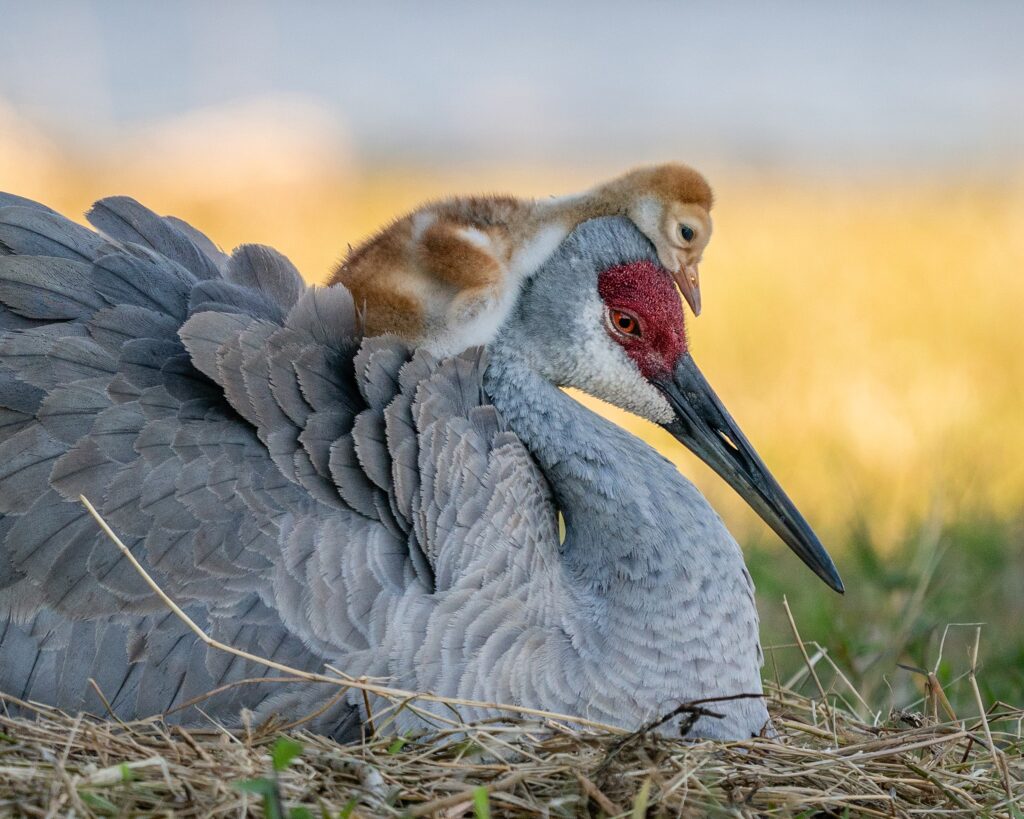
A couple of years ago I led a three-day bird photo “safari” in my local area for about a dozen photographers. They knew little about birds, certainly not how to identify them, but they obtained some fantastic shots, even at a distance or moving birds, or both. I was especially impressed by a shot of Sandhill Cranes, who must have been a half-mile away, standing in a field with the setting sun behind them. (The photo on the left was awarded an Audubon Photography Award.)
Besides their knowledge of photographic methods, the camera enthusiasts burdened themselves with a plethora of equipment – tripods, gear bags full of lenses and whatnot, and usually more than one camera. I swear some of their lenses were two feet long. But I guess that’s what you have to do to get good pictures. One of the photographers asked me why I don’t take bird pictures since I’m always watching them. I said that carrying a bird book, camera, and water bottle was enough for me to drag around.
Bird photography is a challenge, certainly a worthwhile and rewarding one, and when you get a particularly good shot, it might be worth submitting it in a contest. Many types of bird photo contests are held throughout the world. They tend to fall in these categories:
- Species-specific contests focus on individuals or groups of birds such as eagles, owls, or hummingbirds.
- Habitat-specific contests focus on the birds that inhabit specific habitats such as wetlands, forests, or deserts.
- Behavior-specific contests emphasize capturing unique behaviors of birds such as courtship displays, feeding, or nesting.
- Artistic contests center on aesthetic qualities of bird photography, such as composition, lighting, and color.
- Youth contests specifically for young bird enthusiasts, typically under 18 years old.
- Conservation-focused contests promote conservation of bird species and their habitats by showcasing the beauty and importance of birds.
- Travel contests which feature photos of birds from all over the world.
- Wildlife contests in general with no specific category.
The rules and categories of these contests vary greatly depending on the organization sponsoring the event. Here are the 13 best wildlife photography competitions for 2023. And more here.
Some other contests:
Audubon
Bird Photographer of the Year
Smithsonian
Wild Birds Unlimited
World Nature Photography Awards
Royal Photographic Society
U.S. Fish and Wildlife Service Photo Contests
Birds and Blooms Backyard Photo Contest
The Raptor Trust Photography Contest
And many more local, national, and global contests. Some offer up to $5000 cash prizes, enough, maybe, to pay for all that fancy gear.
Thanks for that info Roger, and great photo. When I see a good bird photo it usually has one or more of three features – sharpness/in focus, movement (eg, bathing or feeding, and uniqueness. (such as the one above) I wonder what other readers look for?
I enjoy wildlife photography, but not to the extent that I will carry around a heavy camera. For me convenience and opportunistic snapping is the thing. For this I carry around, in my pocket, my trusty and inexpensive Lumix or Nikon camera with up to 30X optical built in zoom. I mostly post my pics. to my facebook group, ‘Creatures in our backyards’ Some folks post much sharper pics than I do and they invariably have more expensive and bulkier DSLR cameras. I love the variety, taken on everything from DSLRs to phones.
What an inspiring read! Bird photography truly combines patience, timing, and creativity. Contests like these not only celebrate skill but also raise awareness about wildlife preservation. For anyone editing their bird shots, understanding the difference between photoshop express vs lightroom can make a big difference in achieving the perfect balance between detail and natural beauty.
They don’t hold still, they don’t pose at optimal angles, and they almost always seem to choose the worst possible lighting. That context matters, especially when people judge results without understanding the conditions under which the photos were taken.
Thanks! I’ve found that getting solid portraits of birds in good detail makes all the difference when sharing shots online or entering contests, especially if the background isn’t too distracting.
Lately I’ve been experimenting with getting some of my favorite bird photos professionally printed and framed to hang at home, and it turned out way better than DIY printing.
And jcpenney portraits https://jcpenney-portraits.pissedconsumer.com/review.html I tried handled the color accuracy and sizing spot-on for wildlife shots, which surprised me since I was worried about losing feather detail in the prints.
This is a thoughtful take on bird photography and contests. The practical examples really help illustrate the concepts. If you want a related example, Songonlyone is worth a look.